Herbarium wrap-up, December 2024

The herbarium wrapped up a strong year of outreach, including October table-top tours in the visitor center, which brought information about oaks and the herbarium collections to more than 900 visitors; a set of public tours in May and November; a collaborative Oak-stravaganza collections event that gave staff a deep dive into oak collections in the herbarium, library, and living collections; OAKtober open houses each Thursday of October; a Know-Your-Arboretum (KYA) lecture that illustrated the importance of Herbarium collections for biodiversity research; and public tours for Celebración de los Árboles and Destination Asia Festival. 

In addition, the herbarium completed two major accessibility projects this quarter. The “Relaxing the Collection Project” led by Herbarium Coordinator Lindsey Worcester was a multiyear project to update nomenclature of specimens and reallocate space throughout the collection to allow space for actively growing taxa (particularly oaks, basswoods, sedges, crabapples, walnuts, magnolias, and rhododendrons). Second, the Herbarium and IT together completed a multiyear project to mobilize herbarium data from BRAHMS to several international databases. As of this quarter, we are now feeding herbarium data for more than 102K of our vascular plant specimens, amounting to more than 5,800 species, directly to GBIF and SEINet (thus vplants.org and all the other portals that mirror SEINet). This project was led by Systematics Research Program Manager Marlene Hahn, with Sai Ravichandran (Director of Information Technology), Jeff Funderberg (Network Administrator), and Tom Turner from IT.

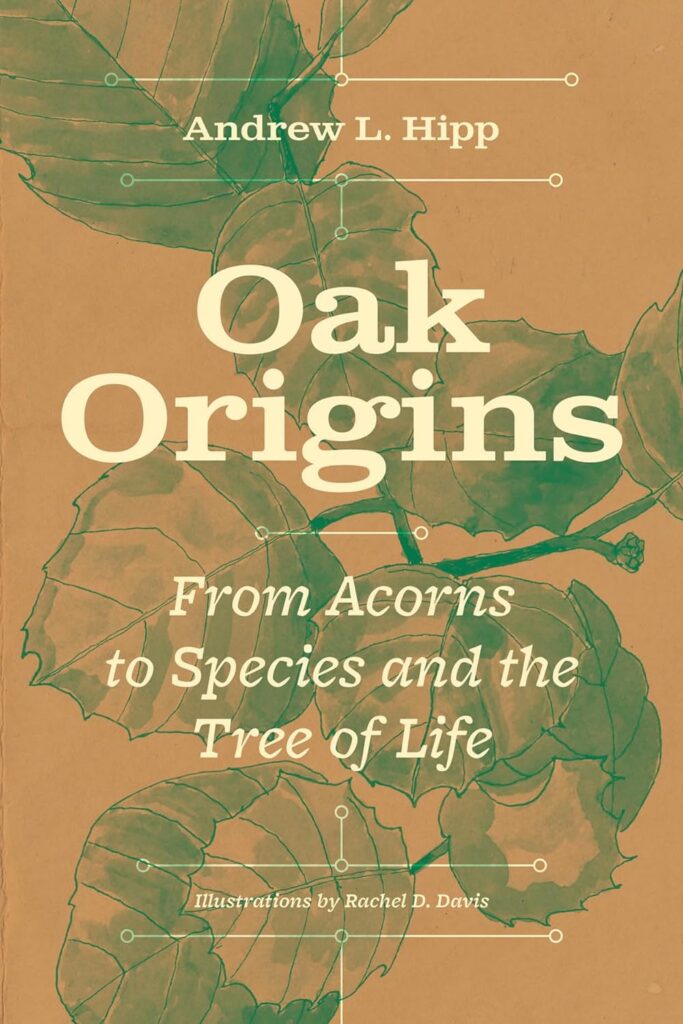
Publication — Oak Origins: from Acorns to Species and the Tree of Life

Andrew Hipp has just published Oak Origins: From Acorns to Species and the Tree of Life, a popular book on oak evolution and ecology, through University of Chicago Press. Described by one reviewer as “a captivating combination of oak natural history and evolutionary biology [and] a must-read for anyone interested in oaks or biodiversity science,” the book makes cutting edge oak biodiversity science accessible to a broad readership and highlights the importance and magnificence of oaks. The book is available in the Arboretum bookstore.

New funded project: Oak genomics in the service of conservation

The Morton Arboretum (including Andrew Hipp, Rebekah Mohn, Marlene Hahn, Alan Whittemore, and Drew Larson) is part of a consortium of 18 institutions who have been awarded a Community Science Program award from the Department of Energy’s Joint Genome Institute (JGI). The project will fund high-quality, annotated reference genomes for 16 oak species of the eastern U.S., as well as whole genome resequencing data for 700 trees representing rangewide samples of each of the 16 species and three experimental plantings of northern red oak (Quercus rubra) and eastern white oak (Q. alba). This work complements and is partly supported by an NSF Dimensions of Biodiversity award to the Arboretum that investigates genome variation in bur oak (Q. macrocarpa) and relatives. Overall, the funded project will help the consortium and other researchers in the community to address two key questions: (1) How has the sharing of genes among oaks species with different environmental adaptations contributed to the ability of oaks to adapt to past climate changes? and (2) what can we learn about hybridization among oaks to assist in conserving and improving their important roles in climate resiliency and bio-based products? Ultimately, this work contributes to our broader understanding of what genes and genome segments define oak species and how oak species remain distinct despite hybridization. These questions are key to conservation and management of oaks and oak forests.

Mosses of The Morton Arboretum

Herbarium affiliates Wayne Lampa, Scott Kobal, Carol Kobal and Pat Armstrong have assembled a guide to the common mosses of The Morton Arboretum. This represents decades of work on the flora of the region, with a focus on mosses in the past two decades.

Download it today! You can get the moss guide at our lab website (herbarium page), and you can see a sample of Wayne’s excellent collections on the CNABH Bryophyte Portal.

Publication: Phylogenetically and functionally diverse species mixes beget diverse experimental prairies, whether from seeds or plugs

A new paper from our Ware Field experimental prairie demonstrates that both seed and plug plantings maintain phylogenetic and functional diversity over time. As seeding is generally more cost-effective for prairie restoration, we recommend focusing on seeding, except where managers require immediate plant cover, or for species difficult to establish from seed.

Barak, R.S., Karimi, N., Glasenhardt, M.-C., Larkin, D.J., Williams, E.W. and Hipp, A.L. (2022), Phylogenetically and functionally diverse species mixes beget diverse experimental prairies, whether from seeds or plugs. Restoration Ecology e13737. https://doi.org/10.1111/rec.13737

Final collections of bur oak and relatives leaf tissue — NSF Dimensions of Biodiversity

Mira Garner and Leah Samuels (Herbarium and Plant Systematics Lab) collected leaf tissue from their 55th and final site this past week for the NSF-funded Dimensions of Biodiversity oak syngameon study that the Arboretum is leading. They collected 530 specimens this summer representing ten species, covering essentially the entire range of bur oak (the red points on the map below show their collection sites). Great work, Mira and Leah!

Visiting researcher: Sofia Zorrilla-Azcué, UNAM – Morelia

Graduate student Sofía Zorrilla-Azcué (UNAM, Morelia) is at the Arboretum for a four-month stay in the Herbarium and Systematics Laboratory. She will be analyzing data from a reduced-representation genomic study (using RAD-seq) into the effects of environment on allele frequency in Quercus insignis, in collaboration with Andrew Hipp and her advisor and Systematics Lab collaborator Hernando Rodríguez Correa.

New paper: drone-based biomass in the experimental prairie

The NSF-funded Ware Field experimental prairie was featured in a paper published this week in Applications in Plant Sciences. The study, “Application of remote sensing technology to estimate productivity and assess phylogenetic heritability,” illustrates the use of drone technology to investigate plant productivity in a diverse (127-species) grassland, and ties the evolution of plant traits to differences among experimental plots in biomass and drone-measured productivity measures. It demonstrates that (1) the traits that shape productivity in our prairie experiment are largely convergent across the tree of life, making the phylogenetic effect of species assemblages on restoration outcomes a complex outcome of descent and modification (Darwin might have predicted that…); and (2) drone-based measures are pretty efficient at capturing biomass: nearly 50% of the among-plot variation in biomass was predicted from drone measures.

The paper was moreover a great Arboretum team effort, led by former RA Lane Scher (now at Duke University) and the PI for the project, Andrew Hipp. Drone based remote-sensing data were collected and analyzed by Scher, with support from Chuck Cannon, the CTS director. Biomass for the project was collected by undergraduate research intern Ashley Tuffin during a 9-month international research internship in the Herbarium and Systematics Laboratory, with support from RA Mary-Claire Glasenhardt. Data analyses were conducted by Scher, Hipp and Tuffin, then data were reanalyzed by Herbarium / Systeamtics postdoc Nisa Karimi, who helped in framing the manuscript. Former Soil Ecologist Bryant Scharenbroch analyzed the soils data and worked with Hipp and Glasenhardt in designing the prairie experiment. It nicely illustrates CTS’s broad range of strengths in both research and mentorship. https://bsapubs.onlinelibrary.wiley.com/doi/10.1002/aps3.11401